

Defining Bloom
Where it all began
Before there was Bloom, there was Money Squirrel: a digital assistant designed to help people make smarter real-time spending decisions and build their savings. The concept explored showing people what they could safely spend after essentials were covered, intervening before problematic spending occurred, and encouraging saving through challenges and rewards. Early testing suggested the idea resonated with customers and pointed to a larger opportunity: reaching people who wanted to save more but were spending roughly as much as they earned each month.
Money Squirrel was pitched alongside other concepts to a strategic investment committee and was selected for continued support. Turning the concept into a product raised questions we still needed to answer. Could we help people understand what they could safely spend? Could rewards make saving easier to start? And how much should a financial product intervene in someone's spending decisions?
When I joined alongside three other designers, we became a multidisciplinary team of about 10 people tasked with figuring that out. We weren't starting from scratch, but we weren't executing against a predetermined product either. We had an audience worth serving, an idea worth exploring, and a lot left to figure out.
Understanding the problem
The Money Squirrel work gave us an initial understanding of who we were designing for and why they struggled to save. Our target audience was adults 18–45 who wanted to save more, typically spent as much as they earned each month, and had less than $10K in investable assets outside of retirement. Early research also suggested that the industry's typical response to this problem –budgeting– wasn't addressing many of the reasons people struggled to save.
We got to work understanding the problem more deeply. Marketing was studying the audience and sharpening our positioning, UX Research explored customers' relationships with money, and I studied the competitive landscape—looking beyond features to understand different products' value propositions, business models, account structures, experiences, pricing, and approaches to behavior change.
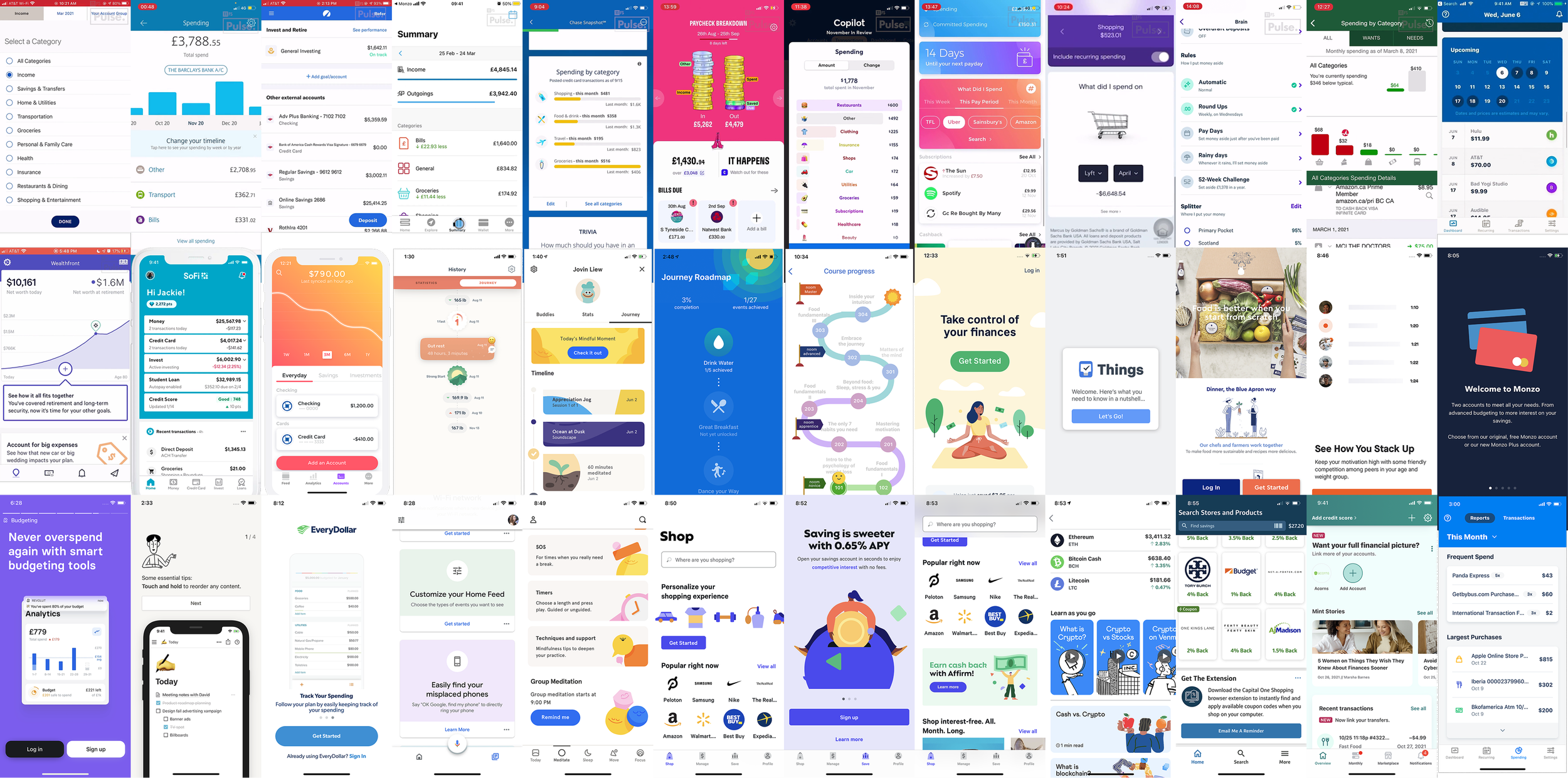
Competitive analysis: evaluated dozens of competitors spanning a broad range of apps and subject matter.
What emerged was a much more complicated picture. Some barriers were practical: managing cash flow, tracking spending, understanding where money was going, or simply not earning enough. Others were behavioral and emotional: temptation, social pressure, emotional spending, low confidence, or not wanting to sacrifice things that made life enjoyable today for an abstract future benefit.
The answer wasn't another tool that asked people to track every dollar or stick to a budget. We needed to meet people where they were and make healthier financial behaviors easier to fit into their lives.
The problem wasn't just money
Some of our early research sessions felt less like product research and more like sitting in on therapy. People talked about shame surrounding their finances. They described not feeling like a “real adult” because they didn't have their finances figured out. They compared themselves with friends who seemed further ahead and felt like they weren't keeping up.
These weren't simply problems with financial literacy or access to the right tools. How people felt about money was influencing how they behaved with it.
That led us to an important product hypothesis: if we could help people feel better and more confident about their finances, it might become easier to build healthy financial habits.
It also pushed us to look outside traditional financial products for inspiration. Lifestyle and wellness apps had been thinking about behavior change, motivation, and emotional well-being for years. We became interested in patterns like reflection, encouragement, small wins, and progress over time—and what we could learn from them about helping people feel differently about their finances.
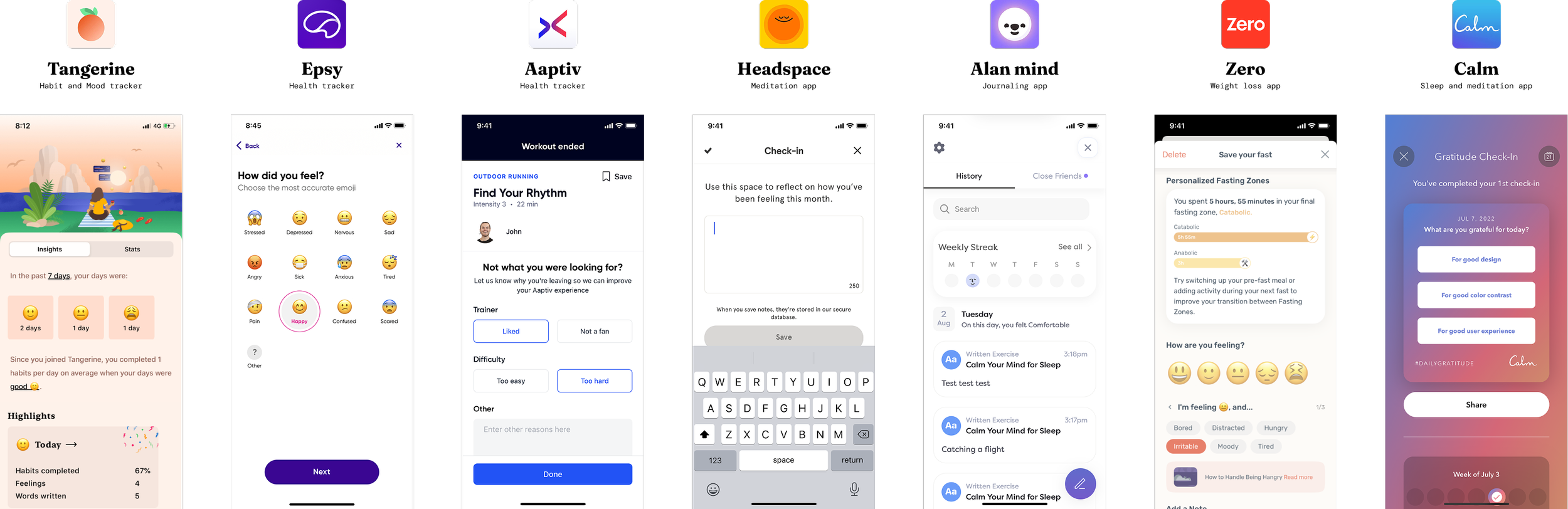
Behavior change exploration across lifestyle apps
Defining our guiding principles
Research gave us a clearer understanding of the barriers our customers faced, but it also forced us to decide what kind of relationship we wanted Bloom to have with them.
We wanted to influence behavior without judging it, turn people's intentions to save into action, and use incentives without making rewards the only reason to act. Those tensions started shaping a set of principles that would guide the product.
Help without judgement
One of the central ideas in the original Money Squirrel concept was to intervene in spending as it happened. We explored sophisticated ways of doing it—from identifying patterns in someone's problematic spending to recognizing when they were approaching a place associated with their spending patterns and nudging them beforehand.
There were a lot of interesting possibilities, but the more we explored the idea, the more paternalistic it felt.
We kept coming back to a familiar piece of financial advice: If you stopped buying coffee every morning, you could save $X instead. The math might be right. But we had no idea what that coffee meant to someone. It might be an unnecessary expense. It might also be the highlight of their morning.
We could identify spending patterns. We couldn't know what that spending was worth to the person making the decision.
If our goal was to improve people's relationship with their finances, constantly reminding them that they shouldn't be spending felt fundamentally at odds with it. Nudges continued to be part of our exploration, but we moved away from the idea that Bloom should police someone's spending.
Turn intentions into savings
People told us they intended to save whatever money remained at the end of the month. The problem was that by then, there often wasn't anything left.
Instead of relying on people to repeatedly make the “right” decision, we became interested in systems that could make saving easier. Automation, account structures, incentives, and intentional friction could help turn someone's intention to save into something that actually happened.
Motivation that lasts
Many of the ideas we explored relied on external motivation: rewards, incentives, challenges, and cash back. Those mechanisms could give someone a compelling reason to take a positive action now, but we didn't want someone to save only because Bloom was rewarding them for doing it.
We were continually trying to balance giving people enough external motivation to get started with helping them build the confidence and habits to sustain that behavior themselves.
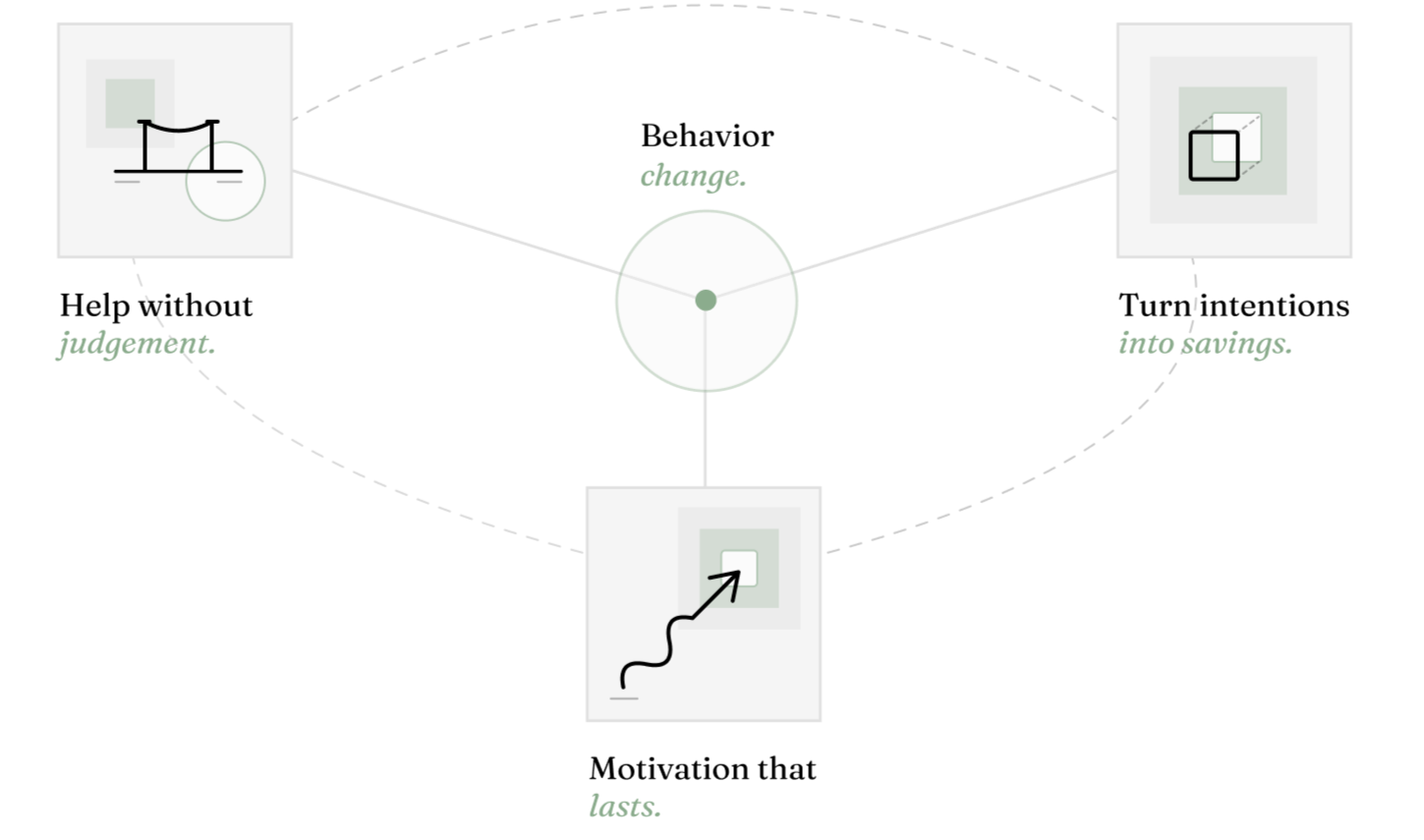
Designing the system behind the behavior
As the product began to take shape, we had to answer a fundamental question: Where should the money live?
We explored several types of financial accounts, including checking and savings accounts, secured credit cards, and investment accounts. Each created different opportunities and constraints, but the account type was only part of the problem. We also needed to decide how customers' money should be organized.
Separating spending from saving
Research showed us a recurring pattern: people intended to save whatever was left at the end of the month, but when spending and saving came from the same pool of money, it was easy to treat the entire balance as available to spend. Keeping track of what was meant for savings required constant mental math—and by the time someone realized they'd spent too much, there was often nothing left to save. What if we could change that by separating savings from the money available to spend? One structure I advocated for was a bucket model with two clear purposes: Spend, for money available to use, and Save, for money intentionally set aside.
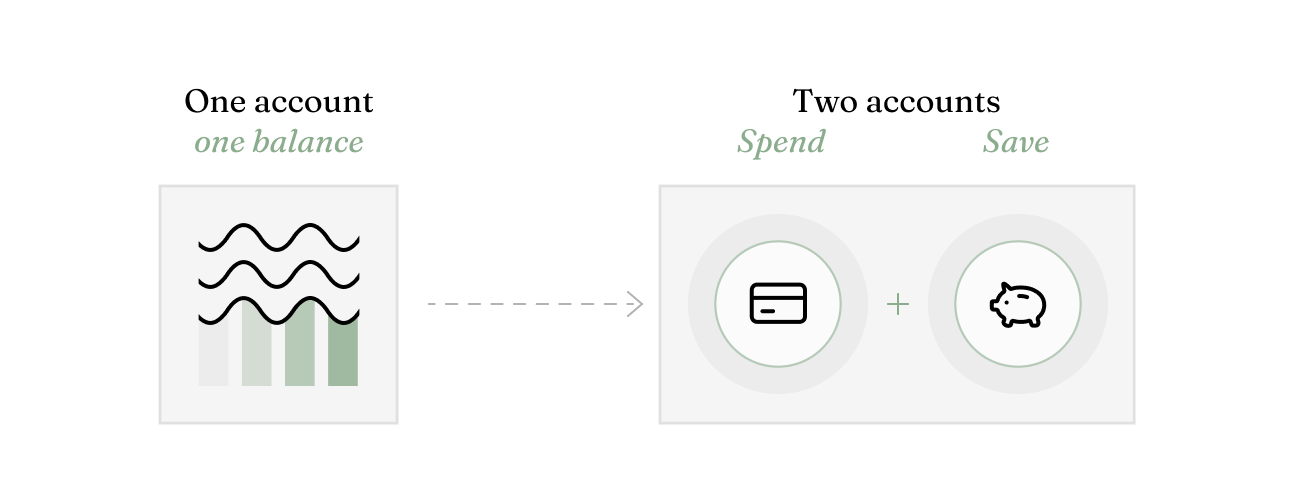
Finding a solution we could actually build
Ideally, the account type and bucket structure would have been designed together around the Bloom customer experience. I was particularly interested in secured credit cards because they could have addressed another meaningful need we saw in our target audience: building credit. In reality, we also had to consider what we could realistically bring to market using the financial infrastructure already available to us.
The most viable path to market was to build Spend and Save on top of our existing brokerage accounts. That allowed us to move faster, but it came with significant drawbacks: greater scrutiny during account opening, slower money movement, unfamiliar concepts like core positions, and fewer of the everyday features customers might expect from a bank account.
It also meant customers technically needed to open two accounts. The existing account opening experience wasn't designed for that, and asking someone to complete essentially the same process twice, back-to-back, wasn't reasonable. We adapted the experience so both accounts could be opened together, hiding as much of that underlying complexity as possible.
We also automatically provided a debit card for Spend, but not Save. That distinction was intentional: saved money remained accessible, but making it slightly harder to spend created a small amount of friction between someone's intention to save and the impulse to use it.
The final architecture was a compromise: two brokerage accounts presented as a simple Spend and Save system. It wasn't the structure I would have chosen without constraints, but it preserved the behavioral idea behind the product while giving us a realistic path to MVP.
Exploring how Bloom could help
Alongside the work to define the underlying financial structure, we explored different ways Bloom could put our guiding principles into practice. Ideas came from across the team and approached the problem from different angles: automatic transfers and round-ups could reduce the effort required to save; incentives and challenges could provide motivation; cash-back shopping could turn everyday spending into savings; nudges could surface opportunities to act at the right moment; and emotional check-ins could help people reflect on their relationship with money over time.
I combined what I was hearing in research with patterns from the competitive landscape to explore different approaches. I developed lightweight concepts—usually just 2–4 screens paired with a short pitch—so we could evaluate an idea before investing heavily in a solution.
Challenges
Could bite-sized, gamified exercises make saving feel more achievable?
I explored Challenges that could progress with a customer, beginning approachable and advancing to be more ambitious and rewarding. The hypothesis was that creating early and frequent wins could build confidence while making saving feel more engaging.

Planned Spending
Could we help people make spending decisions before the moment of purchase?
Rather than buying something and dealing with the financial consequences afterward, I explored helping customers prepare for larger purchases and understand when they could comfortably afford them.
Savings Match
Could a familiar incentive encourage people to save regularly?
Employer 401(k) matches already demonstrated the motivational power of matching contributions. We explored whether a similar mechanism could encourage customers to establish recurring savings behaviors.
Sweepstakes
Could the possibility of a significant reward make positive financial behaviors more compelling?
I explored rewarding financially beneficial actions with entries toward a larger prize—using the excitement of a sweepstakes to reinforce behaviors people already wanted to develop.
These weren't simply features we were assembling into an app.
They were different hypotheses about what might actually change financial behavior.
Defining the MVP
We couldn't pursue everything.
As the product took shape, we had to balance the behaviors we wanted to influence, what we were learning from customers, what differentiated Bloom in the market, and what we could realistically build.
The following became the core features of the app, creating the foundation of our MVP:
Challenges · Savings Match · Shopping · Round up
Planned Spending and Emotional Check-ins were slotted as future features to explore, while Sweepstakes ultimately felt too risky to pursue. The other concepts would play supporting roles within the experience.
The product that emerged wasn't about telling people what not to spend. It was about creating more ways for them to save.
Next: Building Bloom
Defining the product was only the beginning. Next, I'll share how we designed, tested, and evolved the experiences that brought Bloom to life.